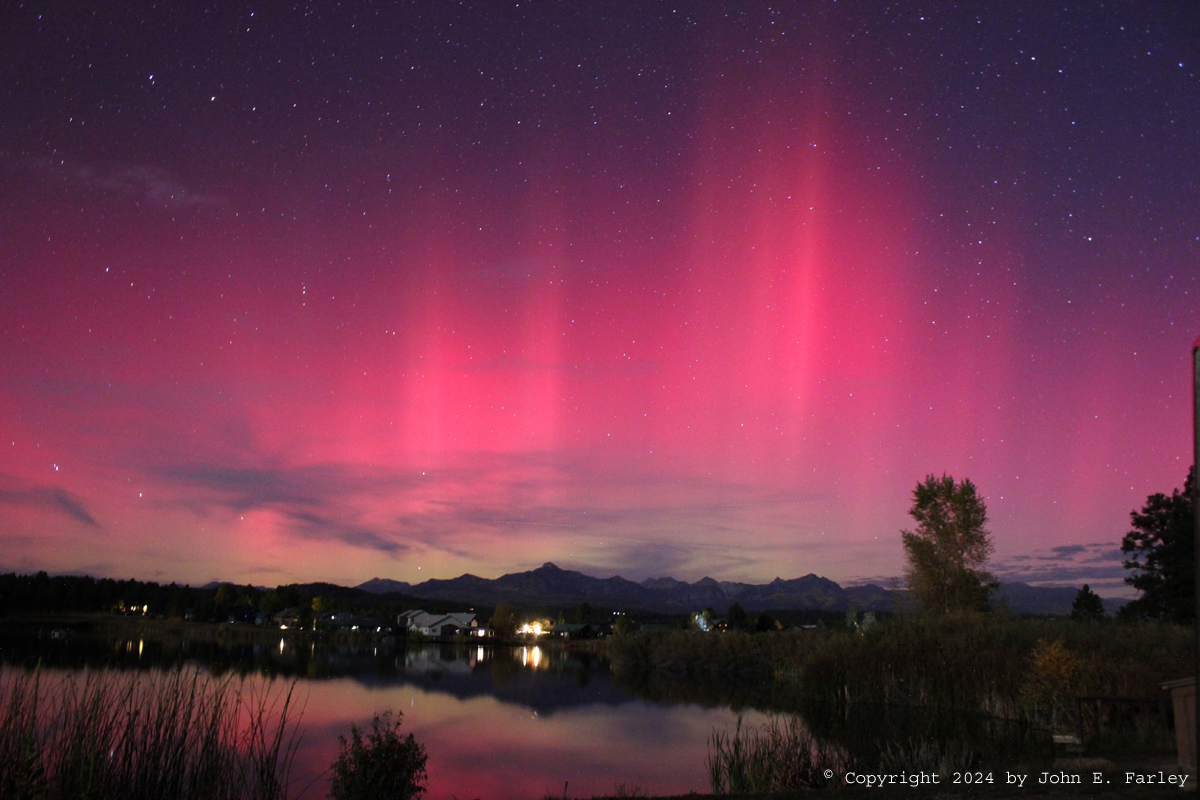
That, of course, was all I needed to hear, and soon I was heading out to the south shore of Village Lake. Having just photographed the northern lights in Santa Fe, NM a few nights earlier, this time I knew what camera settings I wanted and also had a better camera available. So I set the camera, except for focus, before I headed out, and using the crescent moon to get the correct focus for the sky, I started getting decent Aurora pictures from the very first shot, unlike my efforts earlier in the week which took a while to get everything set right. From my location, there is a nice view across the lake which also includes the San Juan Mountains, including Pagosa Peak. So I had a good foreground for the northern lights, and the crescent moon offered just enough illumination to make that foreground visible. As usual with lower-latitude auroras, the color in my pictures is much stronger than what was visible to the naked eye. To the naked eye, there was a dull glow low in the northern sky, with, again like earlier in the week near Santa Fe, a slight hint of a reddish tint. But nothering like what the camera could capture. After I had been there a while, the Aurora intensified somewhat, and a couple vertical pillars of light visible to the naked eye appeared. It was at that time that I got this picture:
I think this was taken somewhere around 10:45 MDT. I would consider this to be my best picture ever of the northern lights. This was the peak intensity of the pillars, and I also like the reflection in the lake and the general foreground with the lake and mountains.
Shortly after the picture above was taken, the Aurora got a little brighter overall, and the pillars widened into what I might call vertically oriented areas of light. Here is a picture:
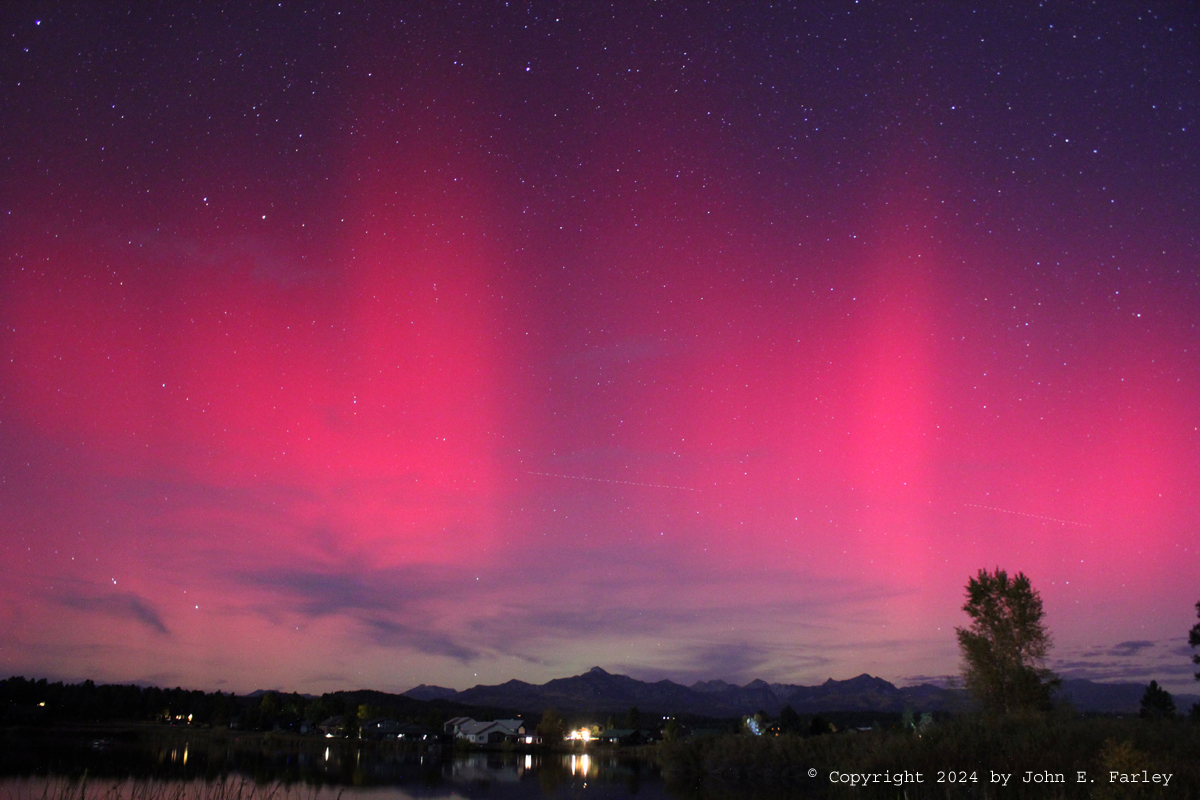
One thing I like about this picture is that in the upper left of the picture, you can see the Little Dipper, including the North Star at the end of its handle. So you can see exactly where things are relative to true north. Because now the lights were extending a little higher, I could not capture the full extent of the Aurora and get the lake into the picture as much, because I was as wide-angle as I could get with the lens I had (18 mm). So a little less of the lake in this one.
The exposure time for both of these pictures was 29 seconds. These are pretty close to out-of-camera; about all I did was darken the mid-ranges a little to improve the contrast and make the dark sky portion of the pictures a little darker. Again, the camera in low light can capture much more color than the naked eye, so these pictures have far brighter colors than could be seen with the naked eye. Amazing to get two such great opportunities to photograph the northern lights at southern locations in the same week!
Return to 2024 Weather Observation Page