Since this was spur-of-the-moment and totally unplanned, I was kind of going by the seat of my pants and ended up having to make many adjustments and corrections, both to my location and my camera settings. The first place I stopped was at the La Chchara trailhead near the intersection of NM 599 and Camino de los Montoyas. Although I probably spent longer at this time than I should have, it proved inadequate due to pinon and juniper trees largely obstructing my view. And at first I had trouble figuring out true north, though eventually I did. And it did look like there was some light near the horizon due north that there was not in other directions, but again, too many trees and hills there to be sure. So I moved a couple miles west on 599 to Camino de la Tierra, the main road into the Las Companas subdivision. There, I could see that there was indeed some light due north, low in the sky and very similar to what I had seen with the May 10 aurora in Pagosa Springs, CO - but this time it did appear to the naked eye to have a bit of a reddish color to it, in contrast to the basically colorless appearance of the aurora to the naked eye on May 10.
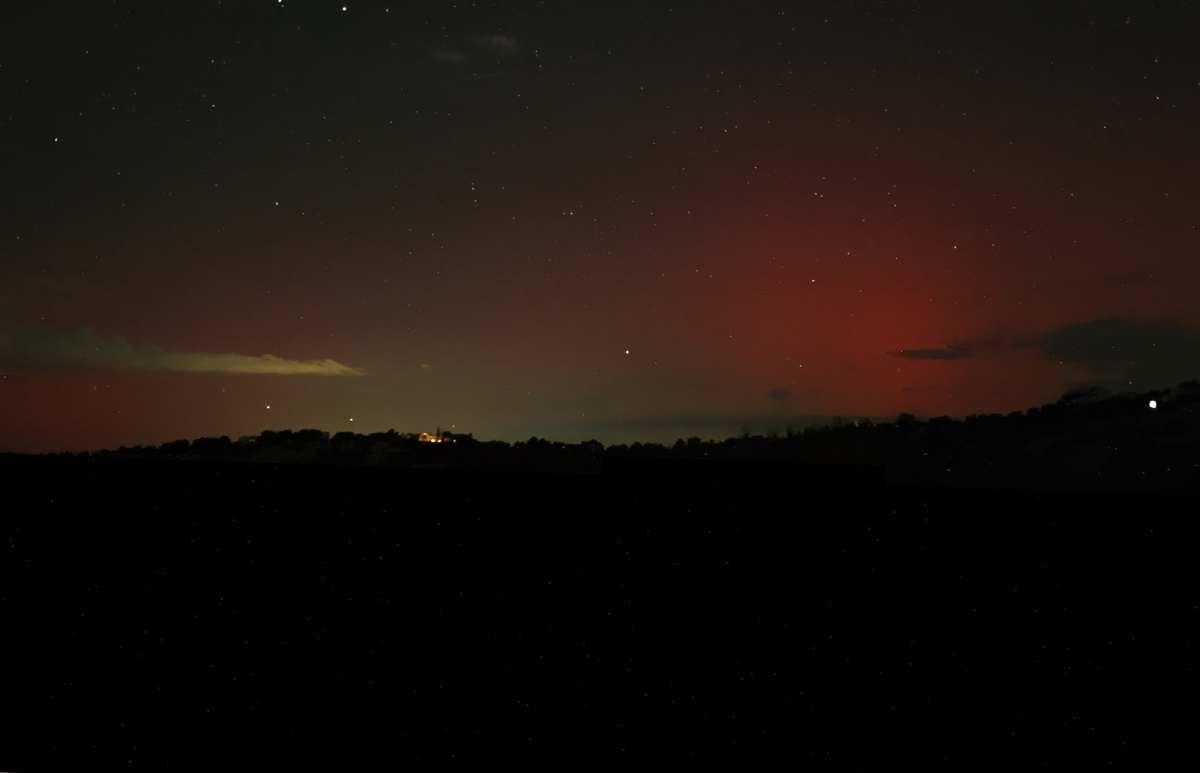
After a lot of fidling with the camera settings, I was able to get this picture, probably the best of the dozen or so in which I captured the aurora:
I was using an old camera - my oldest DSLR, actually - because that was the camera I had available. Unlike the newer DSLRs, at the high ISO setting needed for the low light, the pictures came out quite noisy/grainy. However, with the de-noise feature in Topaz Photo AI, I was able to get rid of most of that. De-noise and some sharpening was really the only admjstments I made to the picture above - the colors in the sky are as they were out-of-camera. The exposure time for this picture was 29 seconds.
Note: Some of the light near the ground in the left-center of the picture is from ground light, not aurora, as evidenced by the fount-lit cloud. But the red colors and some of the greenish color farther to the right near the horizon are aurora. Here is a wide-angle version of the same picture (with some of the ground cropped out), and now with the brightness and colors slightly enhanced - probably similar to what I would have gotten with a longer exposure, like the picture farther down:
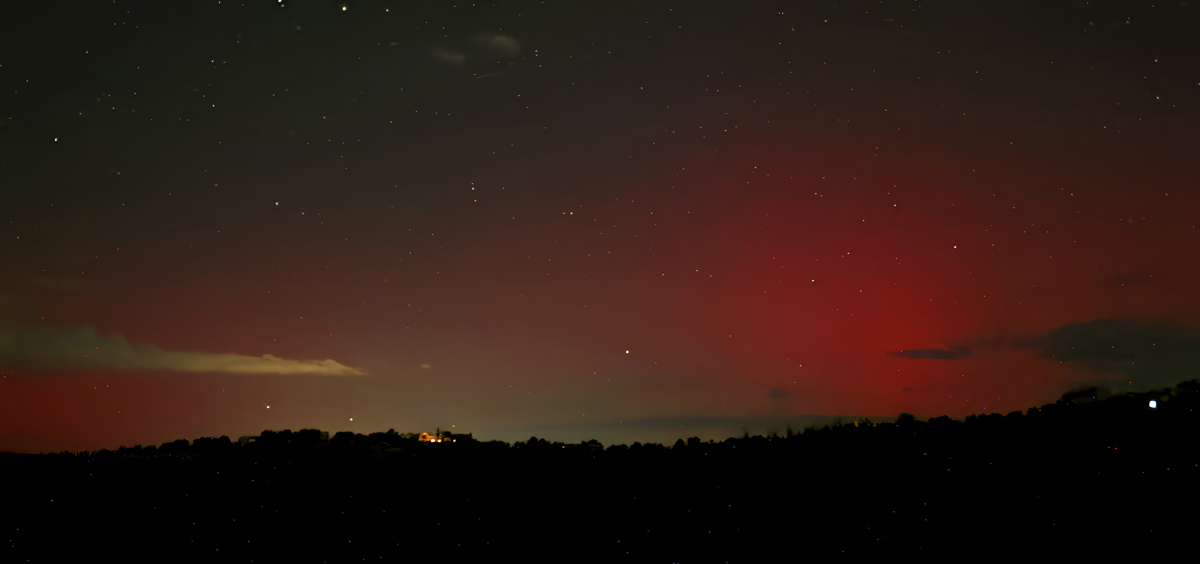
It should be noted that the colors in these pictures, even in the ones with no enhancement, are much more notable than what was visible with the naked eye. This is typical for lower-latitude aurora pictures (and also pictures of some other sky phenomena such as comets), because cameras can capture color that is not visible to the human eye in low light. As noted above, the aurora visible to the naked eye did have a hint of red in it, but nowhere near what the camera captuyred, even in the pictures without color enhancement and in others that I took that are not posted here.
Here is a more zoomed shot taken a little earlier at the same location as the picture above, unfortunately slightly out of focus as I had initially failed to re-adjust the focus after relocating. But I do like the colors:
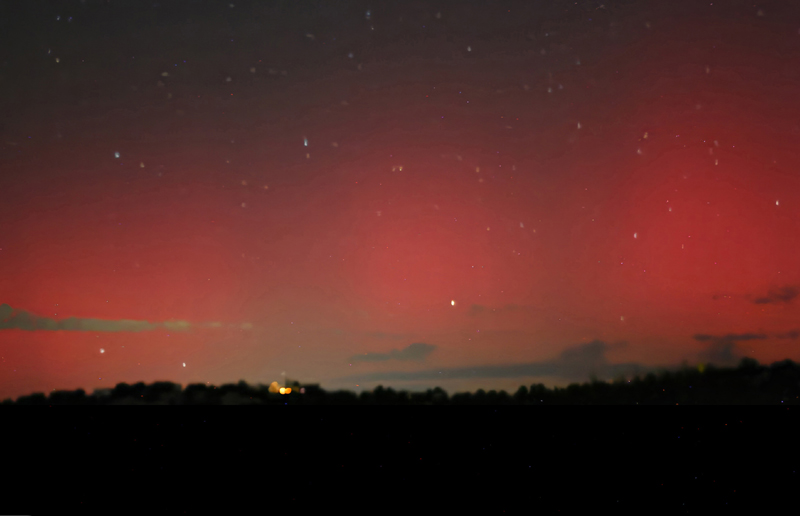
As I said, the exposure time on this one was a little longer than the others above, 39 seconds for this oen vs. 29 for the others. But I think some of the difference also is that the aurora was a little brighter at this time. Perhaps also some of it is that I was zoomed in a little more. There is no color or brightness enhancement in this picture, but I did do quite a bit of sharpening to compensate for the incorrect focus. You can't totally fix that, but you can make it better.
This is my new personal record for southernmost place to see the aurora, replacing Pagosa Springs last May. Wasn't really sure after that one that I would see another one even farther south, but now I have!